
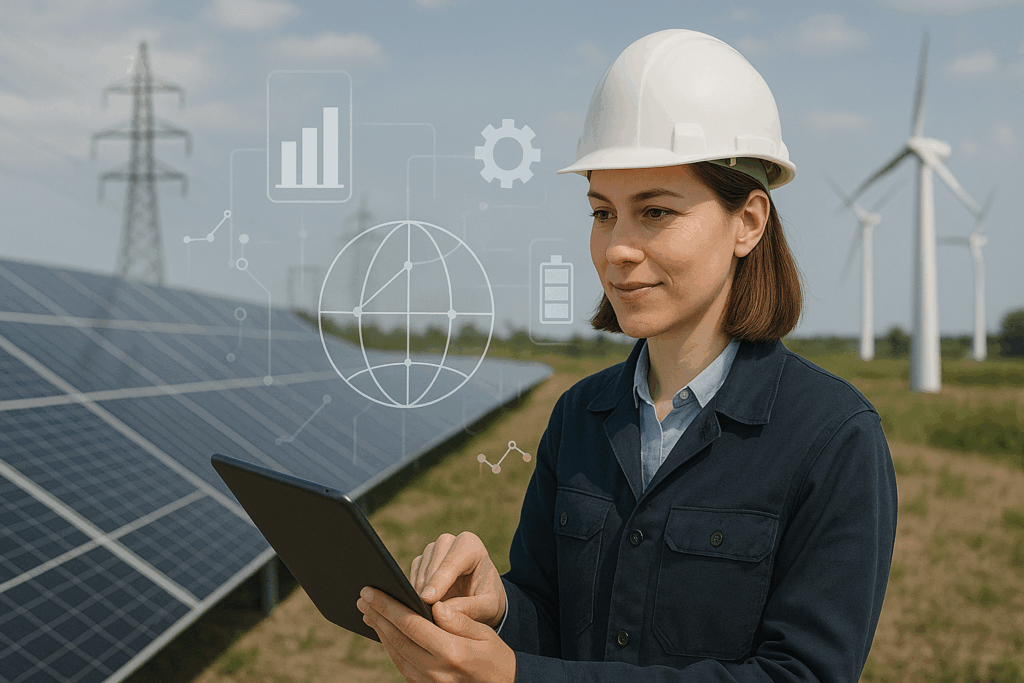
We develop and evaluate techno-economic models—complemented by data-driven analytics and decision-support tools—to evaluate energy systems and technologies, and to guide stakeholders in navigating the opportunities and challenges of the energy transition.
The ongoing diffusion of technologies such as heat pumps, electric vehicles, and PV systems as part of the energy transition poses numerous challenges—not only for the power grid, but also for companies, private households, legislators, and society as a whole. Stakeholders face new investment decisions, structural changes in the labor market, evolving legal frameworks, and shifting social norms. These developments raise pressing questions about both the economic and technical feasibility of such technologies: How profitable are they in specific contexts? And how can they support the management and operation of existing and future energy networks?
A key focus in this research area lies in developing techno-economic models of energy systems and technologies, and in evaluating their performance to provide concrete, actionable recommendations for multiple stakeholders. This helps ensure profitability for individual investors, supports the achievement of energy objectives in neighborhoods and cities, and safeguards the reliable operation of existing energy networks in a changing energy landscape. Beyond modelling, our work also explores complementary approaches—such as data-driven analytics, digital monitoring, and decision-support tools—to address the challenges and opportunities of the digital energy transition.
Current projects
- Thermal comfort as a service: Smart-sensor-based energy management in non-residential buildings
- Demand-response with electric vehicles: charge later, support the grid now
- Local grid vs. global emissions: electric vehicle charging
- Quantifying the potential of electric vehicles for demand-side flexibility
Completed projects
- Solar energy community design: How many members, how many prosumers, what PV system sizes?
- Solar PV sharing in urban energy communities
- Building citizen support for policy decisions via digital feedback interventions
- Wagon, F., Graf-Drasch, V., Fridgen, G., Tiefenbeck, V. (2024), Shaping Stable Support: Leveraging Digital Feedback Interventions to Elicit Socio-Political Acceptance of Renewable Energy. Energy Policy.
- Wörner, A., Tiefenbeck, V., Wortmann, F., Meeuw, A., Ableitner, L., Fleisch, E., Azevedo, I. (2022), Bidding on a peer-to-peer energy market – An exploratory field study. Information Systems Research 33(3), 794-808.
- Mehta, P., & Tiefenbeck, V. (2022). Solar PV Sharing in Urban Energy Communities: Impact of Community Configurations on Profitability, Autonomy and the Electric Grid. Sustainable Cities and Society 87, 104178.
- Pena-Bello, A., Parra, D., Herberz, M., Tiefenbeck, V., Patel, M., Hahnel, U. (2022), Integration of prosumer peer-to-peer trading decisions into energy community modelling. Nature Energy 7, 74–82.